
Canadian geese are not just visitors, they are transplants and claim the title of New Yorker. These geese have turned into year around residents after decades of urban adaptation, and we can only thank New Yorkers.
If you have ever been chased and hissed in Central Park by a goose defending it’s chicks, even though you were foots away, you have encountered one of New York City’s most successful urban adaptors. Once thought of as seasonal travelers, Canadian geese, Branta canadensis, are now year-around New Yorkers.
They nest in Van Cortlandt, give judgmental looks in Prospect Park, and strut down the block like they own it. Geese are not only stubborn, they are also textbook examples of urban adaptation. How it has gotten to this is a direct consequence of how human have influenced the climate, and how wildlife continues to rewriting the rules of what was thought to be expected.
From Migrants to Residents
Most people picture Canada geese as the quintessential migratory bird: V-shaped flocks streaming south in fall, north in spring. But those flocks don’t tell the whole story anymore. In much of the Northeast, resident Canadian geese now spend the entire year in place with little seasonal departure. It is not that they can no longer fly, they can in fact over 1500 miles in 24 hours, rather they are choosing a different path.
Studies have shown these geese are going off course and have developed into a subspecies. A different type of population with different movements and fidelity to local habits. Most distantly, they do not fly far in comparison to original habits.
Urban and suburban landscapes have created ideal conditions: short grass to graze, open water from ponds and retention basins that don’t freeze, and few natural predators. Add warmer city microclimates and protections against hunting, and you have a bird that could survive here instead of flying thousands of miles.
Cities as Evolutionary Filters
Urban life is a series of selective pressures, meaning that certain environmental factors favor specific traits so those with those favor characteristics get to survive and reproduce. For geese that means tolerating humans, exploit manicured lawns, and find safe winter refuges survive and reproduce. Over generations, these traits become more common. Similar to other wildlife like squirrels, raccoons, rats and other city life critters.
In Chicago, researchers tracked Canada geese with GPS and found that birds that stayed in urban zones through winter had survival rates far higher than those that ventured out into agricultural fields where hunting and harsher conditions awaited. This geese in cities found favorable environment where they are safer than flowing the traditional migratory behavior, turning urban space into refuge rather than a dead end.
These geese do not have a problem adapting to the new environment. They can be seen nesting on rooftops, flower boxes, or other elevated structures. Resident geese don’t just tolerate cities, they use them, a behavior unheard of in truly wild settings.
How We Contributed
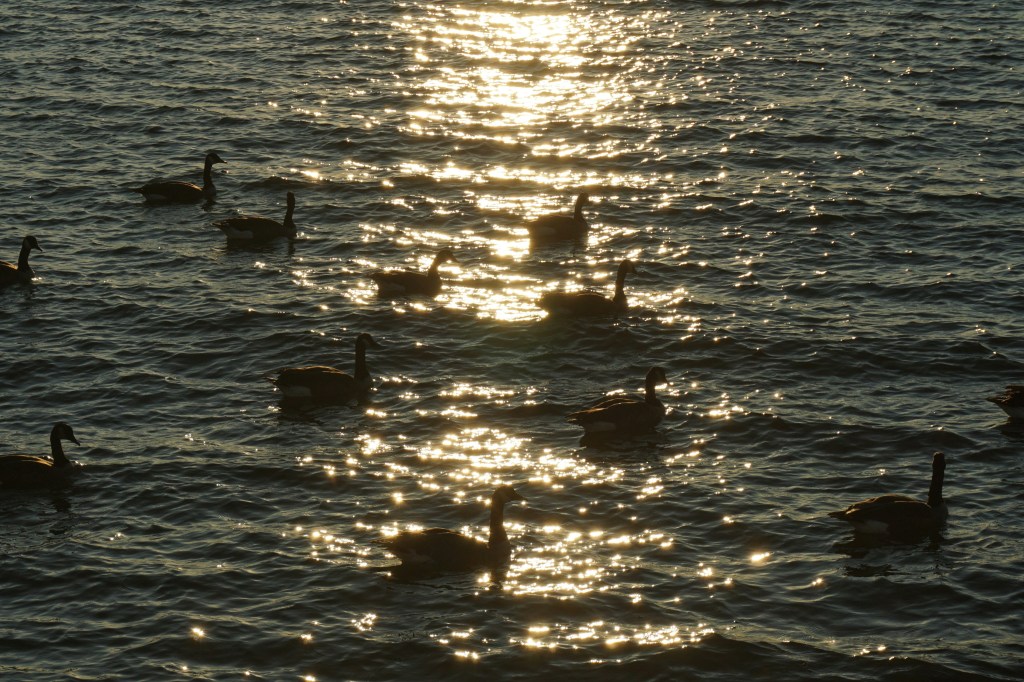
It is not news to know that people impact nature, but perhaps this gives you a different perspective on how. In the early 20th century, waterfowl managers and wildlife enthusiasts released captive-reared geese into parks and refuges to bolster declining wild populations. Many of these birds lacked strong migratory instincts, and in the resource-rich Northeast they thrived.
With the rise of suburbia: golf courses, parks, retention ponds, and green lawns created continuous, high-quality habitat. Urban habitats offered predictable food and secure water, with little hunting pressure and few predators. Over time, geese that could exploit these conditions thrived.
This evolution in behavioral adaptation happened so rapid that perhaps you never took notice. This isn’t evolution in a textbook sense yet.
The Impact of Adaptation
Resident Canadian geese now number in the tens of thousands in New York State alone, far above historical levels. While their presence can be charming goslings bobbing along a lawn it also causes real problems: overgrazed turf, increased nutrient runoff into waterways, not to mention goose droppings in public spaces.
Ecologists caution that massive populations can displace other waterfowl, degrade shoreline vegetation, and alter nutrient dynamics in ponds and lakes. Harming the delicate ecosystem that exists in urban spaces.
What Their Story Tells Us
Canadian geese in New York aren’t failures of migration or evidence we’ve somehow “ruined” nature. They are success stories of adaptation flexible, responsive, and opportunistic. Their evolution from seasonal visitors to year-round residents shows how wildlife rewires its life strategies when humans reshape landscapes at massive scales.
Whether you find them a nuisance or a beloved part of the urban ecosystem, there’s no denying that Canada geese are now as much a part of New York City as the subway and the pigeons and their very presence challenges our preconceptions about what “wild” really means in a metropolis.
 Outer Haven